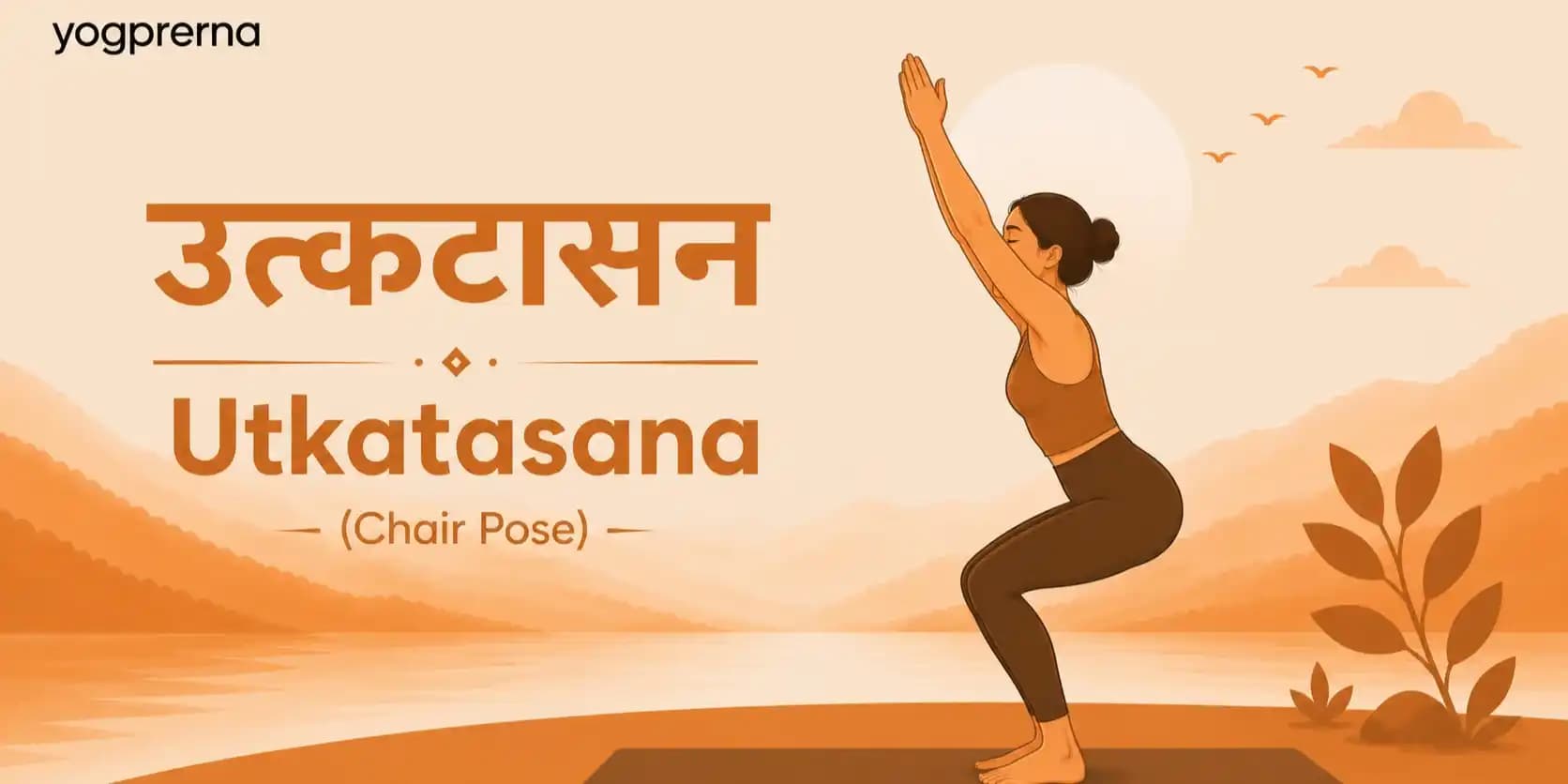
Utkatasana
Utkatasana—derived from Utkata (meaning "fierce," "powerful," or "immense") and Asana (pose)—is a dynamic standing posture that tests mental grit while building functional lower-body strength. Often referred to as Chair Pose, it simulates sitting back into an invisible seat. By requiring sustained isometric contraction across the quadriceps, glutes, core, and shoulder girdle, Utkatasana rapidly generates tapas (internal heat) and anchors stability throughout the entire kinetic chain.
The physical foundation grounds through both feet, positioned either together with big toes touching or parallel at hip-width distance. Weight shifts deliberately backward into the heels, allowing the toes to stay light against the floor. As the hips hinge and lower backward, the knees bend to stay aligned directly over or behind the ankles, preventing shear force on the knee joints.
The lower body acts as a powerful lever. The gluteus maximus, quadriceps, and hamstrings engage simultaneously to hold the deep knee flexion. Hugging the inner thighs toward the midline engages the adductors and stabilizes the pelvis. The tailbone lengthens downward toward the earth, drawing the lower abdomen upward to prevent hyper-lordosis (excessive arching) in the lumbar spine.
The upper body extends dynamically against gravity. As the arms sweep overhead parallel to each other with palms facing inward (or touching), the latissimus dorsi, deltoids, and triceps engage to maintain shoulder elevation. Broadening across the collarbones keeps the shoulder blades sliding down the back away from the ears. The chest stays proud and open, with the gaze focused forward or soft toward the thumbs while maintaining deep, diaphragmatic breath.
Intensely strengthens the quadriceps, gluteal muscles, hamstrings, and calves, reinforcing knee joint stability.
Requires strong activation of the rectus abdominis, obliques, and transverse abdominis to stabilize the pelvis and protect the lower back.
Overhead arm extension stretches the pectorals and latissimus dorsi while strengthening the upper back and shoulder stabilizers.
Large muscle group integration elevates the heart rate, builds endurance, and stimulates cardiovascular stamina.
Alignment Note: A common mistake is letting the knees drift forward past the toes or collapse inward toward each other. Keep your center of gravity shifted back into your heels so you can comfortably see your toes when looking down, and maintain firm engagement through the outer hips to keep knees tracking parallel.
| Variation | Purpose | Description |
|---|---|---|
| Parivrtta Utkatasana | Spinal rotation & detoxifying squeeze | Bringing palms together at the heart center and twisting the torso to hook an elbow over the opposite outer thigh adds a deep spinal detox. |
| Block Between Thighs | Adductor & core engagement | Squeezing a yoga block tightly between the inner thighs during the hold prevents knees from collapsing and optimizes inner-leg firing. |
| Utkatasana on Tiptoes | Ankle stability & balance challenge | Lifting the heels off the mat while staying low in the seat shifts the load onto the toe mounds, intensely working the calves and ankles. |
Chair Pose (Utkatasana) is a standing yoga posture in which you bend your knees, shift your hips back as if sitting on an imaginary chair, and extend your arms overhead. It is a powerful strengthening pose that builds endurance, improves balance, and is commonly practiced in Sun Salutation variations and standing yoga sequences.
Chair Pose strengthens the thighs, glutes, calves, ankles, and core while improving balance and stability. It also stretches the shoulders and chest, enhances posture, increases lower-body endurance, and helps develop focus and body awareness.
Stand with your feet together or hip-width apart. Inhale and raise your arms overhead with your palms facing each other. Exhale as you bend your knees and push your hips back, as though sitting into a chair. Keep your chest lifted, spine long, core engaged, and knees aligned over your feet. Hold the pose while breathing steadily, then return to standing.
Yes. Chair Pose is suitable for beginners, although it can be physically demanding. Beginners can reduce the depth of the squat, keep their feet hip-width apart for greater stability, and hold the pose for a shorter duration while building strength.
Most practitioners hold Chair Pose for 20–60 seconds or 5–10 deep breaths. Beginners may start with shorter holds and gradually increase the duration as strength and endurance improve.
Chair Pose primarily strengthens the quadriceps, glutes, hamstrings, calves, ankles, core, and back muscles. It also stretches the shoulders, chest, and upper back while improving stability throughout the body.
Chair Pose is commonly associated with the Manipura (Solar Plexus Chakra) because it builds strength, confidence, determination, and inner energy. It also supports grounding through the Muladhara (Root Chakra) by creating a stable foundation.
Common mistakes include allowing the knees to collapse inward, arching the lower back excessively, lifting the heels off the floor, shrugging the shoulders, leaning too far forward, and placing too much weight on the toes. Keeping the weight in the heels and the core engaged helps maintain proper alignment.
People with severe knee injuries, ankle injuries, hip problems, or chronic lower back pain should practice Chair Pose with caution or under the guidance of a qualified yoga instructor. Those with shoulder discomfort can keep their hands on their hips or extend the arms forward instead of overhead.
Yes. Chair Pose is one of the most effective yoga poses for building strength and endurance in the quadriceps, glutes, calves, and ankles. Regular practice can improve lower-body stability and support functional movements such as walking, climbing stairs, and squatting.