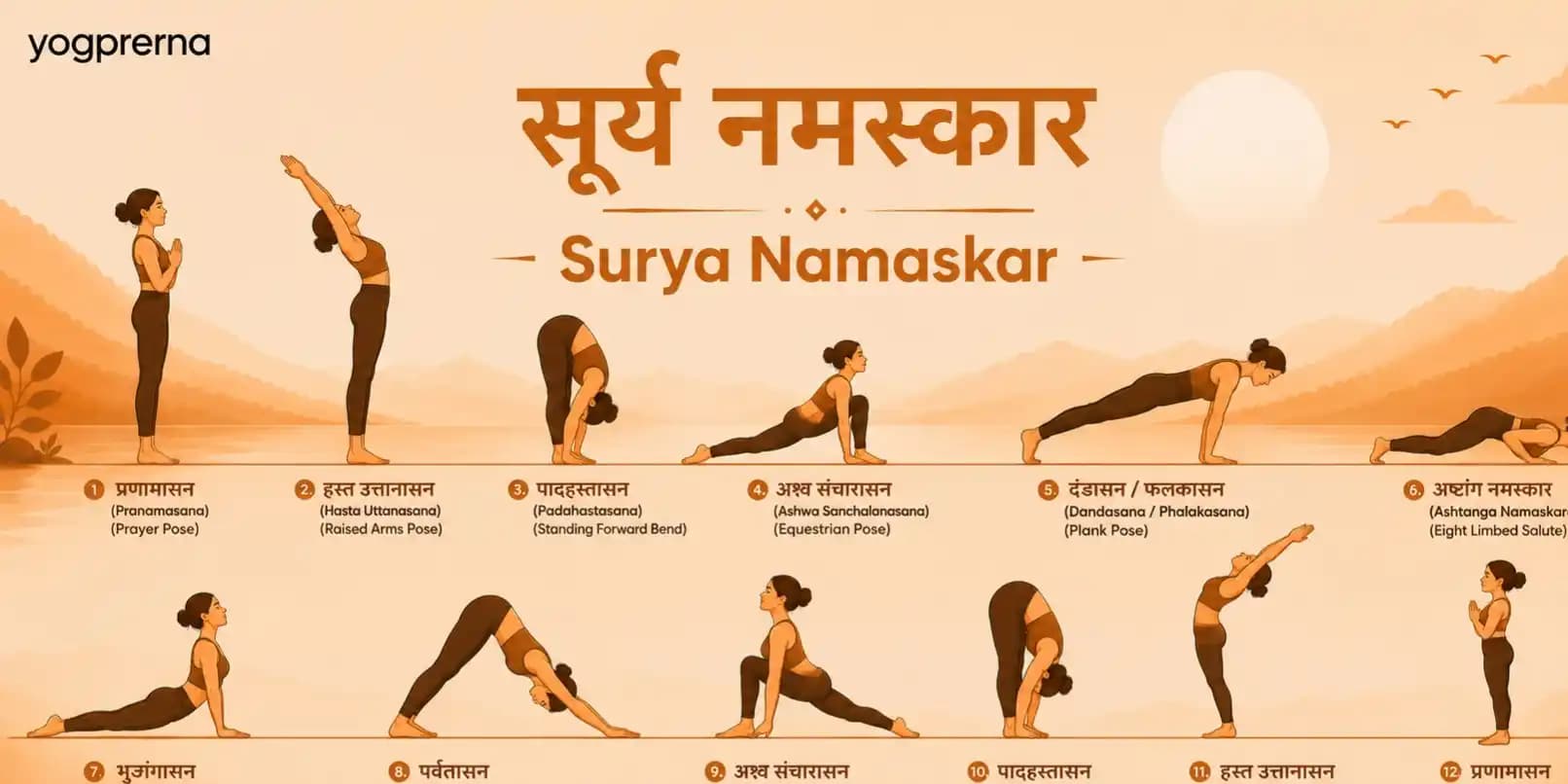
Surya Namaskar
Surya Namaskar—meaning "Salutation to the Sun"—is a traditional sequence of yoga postures performed in a continuous, rhythmic flow. Rather than being a single asana, it combines forward bends, gentle backbends, strengthening positions, and controlled transitions into a coordinated practice. Each movement is traditionally linked with the breath, creating a dynamic sequence that warms the entire body, mobilizes the major joints, and prepares the muscles and spine for deeper yoga practices.
The sequence begins from a stable standing position with the feet grounded and the spine naturally elongated. As the practitioner moves through the sequence, the body transitions between standing, forward-folding, plank-like, prone, and upward-facing positions. The movements should remain controlled, with the spine lengthened rather than compressed during transitions.
During the forward fold, the movement should originate primarily from the hip joints while the knees may soften according to individual flexibility. In the plank position, the shoulders remain aligned over the wrists while the abdomen and legs actively support the body. During the transition toward the floor, the elbows stay controlled rather than flaring excessively outward.
The backbending portion should be created through an even extension of the spine rather than forcing the lower back. The chest expands while the shoulders remain away from the ears. As the sequence returns through downward-facing and forward-folding positions, the practitioner maintains steady breathing and controlled weight distribution through the hands and feet. The final standing position restores the spine to an upright, balanced alignment.
Moves the spine, shoulders, hips, knees, ankles, and wrists through a broad range of controlled movements, making it an effective whole-body warm-up.
Repeated transitions engage the legs, glutes, abdominal muscles, shoulders, arms, chest, and back while supporting functional strength and endurance.
Performing the sequence continuously at a steady pace elevates the heart rate and can improve stamina while increasing overall physical activity.
Linking each movement with inhalation and exhalation encourages rhythmic breathing, concentration, body awareness, and smoother transitions between postures.
Alignment Note: Avoid treating Surya Namaskar as a race. Moving too quickly can compromise spinal alignment, place unnecessary stress on the wrists and shoulders, and encourage excessive lower-back compression. Keep the transitions controlled, distribute weight evenly through the hands and feet, engage the core, and adapt the depth of each posture to your individual mobility and strength.
``` ```
| Variation | Purpose | Description |
|---|---|---|
| Surya Namaskar A | Foundational flow & full-body warm-up | A streamlined sequence that moves through standing, forward fold, plank, a controlled lowering phase, upward-facing backbend, downward-facing position, and a return to standing. |
| Surya Namaskar B | Strength & dynamic conditioning | A more demanding variation that incorporates Utkatasana (Chair Pose) and Virabhadrasana I (Warrior I), increasing the involvement of the legs, hips, core, and shoulders. |
| Modified Surya Namaskar | Accessibility & controlled practice | The sequence can be adapted by lowering the knees during plank transitions, shortening the forward fold, reducing the depth of backbends, or using slower movements to accommodate individual strength and mobility. |
Sun Salutation, or Surya Namaskar, is a sequence of 12 yoga poses performed in a flowing movement. It improves flexibility, strength, balance, and overall fitness while synchronizing breath with movement.
The 12 traditional poses are:
Regular practice improves flexibility, strengthens muscles, boosts cardiovascular health, aids digestion, enhances posture, increases energy, and supports mental well-being.
Beginners should start with 2–4 rounds and gradually increase to 6–12 rounds as strength and endurance improve.
Yes. Sun Salutation engages the arms, shoulders, chest, core, back, hips, glutes, and legs, making it an effective full-body exercise.
Yes. Practicing Sun Salutation daily can improve flexibility, stamina, mobility, and overall health when performed with proper technique.
The ideal time is early morning on an empty stomach, preferably facing the rising sun. However, it can also be practiced in the evening if your stomach is empty.
Yes. Performing multiple rounds at a steady pace burns calories, boosts metabolism, and supports weight management when combined with a healthy diet.